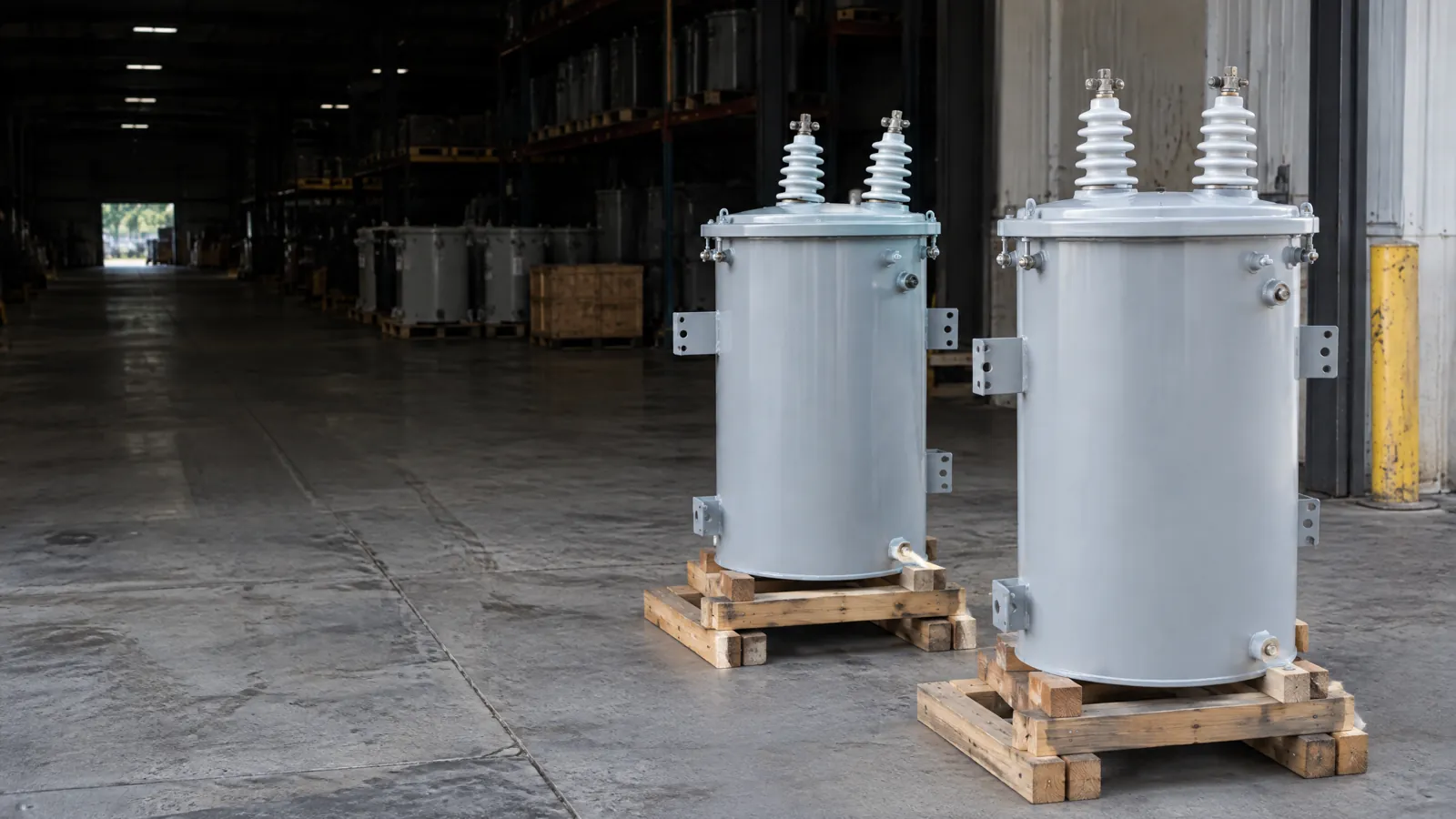
Pole-Mounted Transformer Buyers
Have a retired overhead transformer or unused pole-mounted units from a canceled project? Surplus Valve Buyer is an independent Houston-based surplus equipment purchase review business. We review reusable used and new surplus transformers individually, with attention to the nameplate, ownership, condition and insulating-fluid records. Start with the quantity, location and what you know about the equipment; photos are optional. This page focuses on single-phase liquid-filled overhead units, including individual transformers removed from a bank. Equipment still on a pole needs a different conversation from surplus already stored in a yard, especially when utility ownership or electrical status is unresolved.
Identify the overhead unit you are selling
Describe the transformer itself rather than only the service it supplied. Eaton explains that a three-phase overhead bank can consist of three single-phase pole-mounted transformers. If your surplus came from a bank, identify each unit and its own rating instead of presenting the bank rating as the capacity of every tank.
Include the manufacturer, serial number and conventional or completely self-protected designation from existing records. A cylindrical tank alone does not establish design, voltage or purchase eligibility.
Keep kVA and primary-voltage notation intact
Copy the kVA rating exactly, including a decimal where present. Eaton's conventional overhead product page lists 25, 37.5 and 50 kVA among its ratings. These are identification examples, not acceptance promises. kVA means kilovolt-amperes; do not rewrite it as an equivalent kW rating.
Preserve the full primary notation. Eaton gives 7200/12470Y V as a single-phase voltage-designation example. Do not split it into primary and secondary values or drop the Y. Send existing plate wording and diagrams rather than a number recalled from memory.
Record the secondary separately
A 120/240 V secondary is a documented overhead-transformer example: Eaton lists it for its Cooper Power series Envirotran single-phase overhead product. That does not mean every pole-mounted transformer has that secondary. Report your unit's low-voltage marking separately from its primary notation.
Include frequency and the connection diagram from existing documentation. Send complete multiple-voltage or tap information; do not change settings for a sale. Names and ratings here are reference examples only. Surplus Valve Buyer is not affiliated with Eaton.
Confirm ownership before discussing a sale
Tell us who owns the transformer and may authorize its sale. Do not assume ownership because it stands on your property or served your building. Resolve possible utility ownership before offering the unit.
For utility surplus or contractor-held equipment, provide the relevant release, invoice, surplus award or written sale authorization when available. Distinguish equipment you purchased from equipment you removed or are temporarily storing. An unresolved ownership question cannot be settled by a nameplate photograph, and purchase review is not permission to remove utility assets.
Explain why it became surplus
An unused project spare, a working unit retired during an upgrade and a transformer removed after a fault need different descriptions. State the removal reason, last known operating condition and whether there is an existing test report. If condition is unknown, say so rather than calling it tested or ready for reuse.
For new surplus, include purchase paperwork and storage history. For rebuilt units, retain repair records. Match documents to each tank and serial number; a report for another member of the bank does not identify this transformer.
Describe mounting hardware and exterior condition
Overhead construction details deserve their own description. Eaton's catalog identifies hanger brackets, lifting lugs and high- and low-voltage bushings. Tell us about missing brackets, visibly damaged bushings, tank dents, corrosion or evidence of seepage already noted by qualified personnel. Existing yard photos can help, but close-up access is not a requirement for the first message.
Do not climb a pole, open a tank or handle terminals for sale details. State whether it remains mounted or was professionally removed. Exterior condition and mounting components do not prove electrical serviceability.
Keep fluid identity and PCB evidence together
Liquid-filled does not automatically mean mineral oil. Eaton offers conventional overhead transformers with mineral insulating oil or FR3 fluid. Send the documented fluid identity, manufacturer markings, service history and any PCB laboratory report. Fluid eligibility is assessed case by case; a fluid trade name is not a substitute for the unit's records.
Under 40 CFR 761.2, concentration can be established by testing, or manufacturer concentration documentation with servicing-fluid records. Match documents to the serial number. Describing a unit as old, newer or oil-filled does not establish actual PCB concentration.
Address unknown PCB status before movement
EPA's rules include specific concentration assumptions for use when information is missing. Pre-July 2, 1979 pole-top distribution transformers are assumed mineral-oil filled; mineral-oil equipment from before that date without established concentration is assumed PCB-contaminated. These regulatory assumptions are not laboratory results, and age alone is not a zero-PCB assurance.
Disclose missing records, PCB markings, leaks and prior fluid changes. Do not drain, mix fluids or strip the transformer for sale. EPA prohibits dilution to evade applicable PCB disposal regulation. Regulated waste needs an appropriate compliance route, not an ordinary surplus-sale assumption.
Separate purchase review from electrical removal
A transformer still connected overhead is not ready-to-load surplus. OSHA requires exposed energized electrical work to be performed by qualified employees and equipment to be treated as energized unless properly deenergized. Qualified personnel and the responsible owner must handle electrical work; this purchase page supplies no removal or installation instructions.
For units off the pole, provide the ZIP code, quantity, documented weight and access constraints. Describe loading availability without arranging lifting solely for an inquiry. Review does not guarantee an offer, pickup capacity or collection date.
Start with the information you already have
No complete technical package is needed to begin. Call or email with quantity, location, used or new-surplus condition and ownership. Add kVA and complete voltage markings if known. Photos remain optional.
For mixed lots, separate ratings and conditions. Later details can clarify acquisition suitability or missing records. Keep ownership, electrical status and fluid questions visible throughout review, rather than resolving them after a sale.