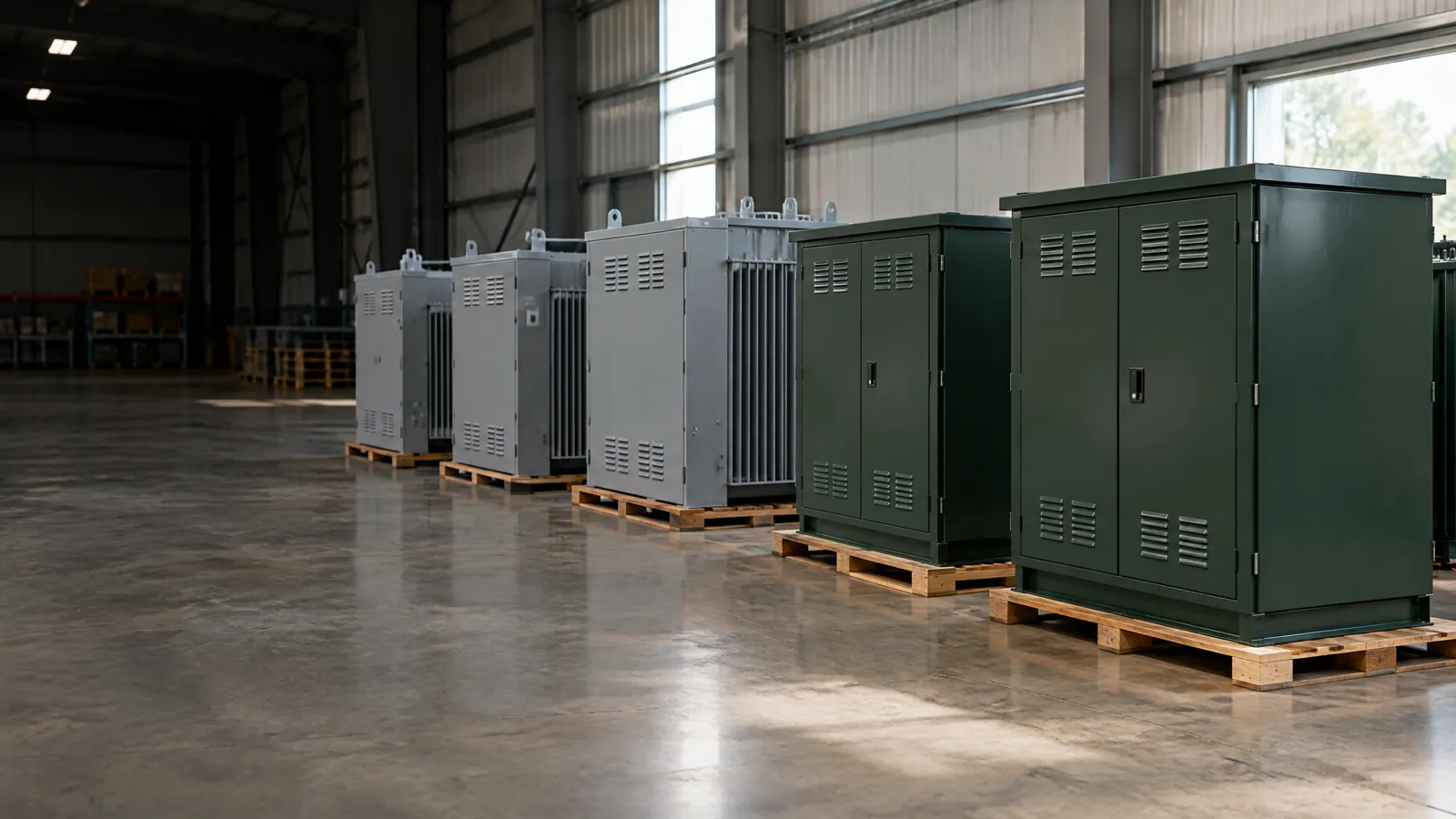
Transformer Nameplate Guide
Before selling a surplus transformer, copy what its nameplate actually says—not what a storage tag or an old project description suggests. Exact identifiers and ratings help a buyer distinguish the equipment and decide what additional information is needed. This guide explains which fields to record, how to preserve voltage notation, and when to leave a detail unknown. Surplus Valve Buyer provides independent, Houston-based purchase review for reusable used transformers and new surplus equipment. You can start with a short phone call or email. Photographs are optional at first contact, and no nameplate detail is worth opening energized equipment to obtain.
Start with safe access, not an open enclosure
Use existing photographs, equipment records, or a safely accessible plate without opening electrical compartments. Some units have an external plate; do not assume every transformer does.
Never open an energized enclosure or reach toward terminals for a better photograph. OSHA requires electrical safety procedures and qualified-person verification before exposed equipment is treated as deenergized. A unit described as disconnected is not, by that description alone, safe to access. Qualified personnel must handle electrical work and any access requiring electrical isolation.
Separate manufacturer, model and serial number
Copy the manufacturer, model or catalog number, and serial number into separate fields. Preserve letters, leading zeros and suffixes. A facility tag is not the manufacturer's identifier.
Eaton asks for the complete nameplate serial number when requesting substation-transformer service. Schneider Electric's replacement-nameplate guidance asks for catalog number, date code and plant code, with its Quote to Cash number if available. Keep those fields separate in your message. If a character is unreadable, mark it uncertain rather than completing it from memory.
Copy the capacity with its original unit
Copy the complete apparent-power rating and its unit: VA, kVA or MVA. Do not substitute kW or estimate capacity from enclosure size.
As a reading example, Schneider Electric's EXN75T3H datasheet lists 75 kVA. Eaton's three-phase pad-mounted specification separately includes 500 kVA among its ratings. These are manufacturer examples, not equipment offered here or acceptance promises. If your plate lists several capacities, copy every entry with its associated cooling or temperature designation rather than reporting only the largest number.
Keep each voltage beside its winding name
Keep each voltage beside its original winding name: primary, secondary, HV, LV or another printed label. Preserve delta, wye, Y, slash marks and additional winding entries.
For example, Schneider Electric identifies EXN75T3H as having a 480 V delta primary and 208Y/120 V secondary. Its separate single-phase FAQ uses 240 x 480 V and 120/240 V, explaining that x means 'or' while the slash means 'and' in that context. Those markings are not interchangeable. Copy the notation; leave connection decisions to qualified personnel.
Record phase and frequency independently
Record phase and frequency separately. Do not infer them from appearance or storage location; leave unreadable fields unknown.
The EXN75T3H manufacturer datasheet, for example, expressly lists three phase and 60 Hz. That verifies the example, not your unit. If the frequency field is missing or obscured, say so. Existing manufacturer documents tied to the exact catalog number can help clarify a missing field without exposing electrical parts.
Read impedance without rounding or guessing
Copy the impedance percentage and printed label, retaining any rating or temperature reference. Keep impedance separate from efficiency and other percentages.
Eaton's pad-mounted specification ties impedance entries to capacity and secondary-voltage categories. That is a reason not to assign a standard percentage to an unidentified transformer. Report the actual plate value if readable; otherwise report 'impedance unknown.' A catalog example cannot establish the measured or specified impedance of a different serial-numbered unit.
Keep cooling, temperature and fluid details separate
Record cooling designations exactly, including multiple entries. Keep winding temperature rise separate from insulation-system information; Schneider Electric's example datasheet distinguishes these fields.
For liquid-filled equipment, record the stated fluid name and quantity with their units, then note any documented fluid changes. Do not identify the fluid by tank color or assume a dry-type transformer has oil. Leave fluid in place: draining or stripping equipment is not a requirement for an initial review, and fluid eligibility is assessed case by case.
Preserve the wiring diagram and tap table
Preserve the whole nameplate wiring or winding diagram in existing photographs or records. Include terminal labels and connection designations, not just voltage numbers.
Copy the tap table separately from the nominal winding voltage. A printed list of available taps does not establish the present tap position. Eaton's dry-type manual refers to the nameplate wiring diagram and prohibits changing connections or taps while energized. This guide asks for documentation only—not opening compartments, moving taps, tracing conductors or testing voltage.
Treat PCB markings as documentation, not assumptions
For liquid-filled equipment, share existing PCB labels, laboratory reports and fluid-service records. Keep equipment identifiers and sample dates visible. Age or an 'oil' label does not establish PCB-free status.
EPA's PCB requirements are in 40 CFR Part 761. Section 761.2 contains specific concentration assumptions for use and permits establishing concentration through testing or manufacturer documentation combined with service records. A regulatory assumption is not a laboratory result or proof of zero PCBs. Unknown status needs case-by-case review before sale or movement; qualified environmental personnel should address any sampling or handling requirements.
Send a short identification message first
Start with known identifiers and ratings, quantity, location, and new-surplus or used condition. Identify the information's source. Keep each unit's serial number with its own ratings.
Call (951) 403-5738 or email industrial832@gmail.com. Optional existing photos and test records can follow. Surplus Valve Buyer reviews purchase possibilities independently and is not a manufacturer representative. Nameplate information supports identification; it does not certify condition, establish reuse suitability or guarantee an offer. Missing details can be discussed without unsafe access.