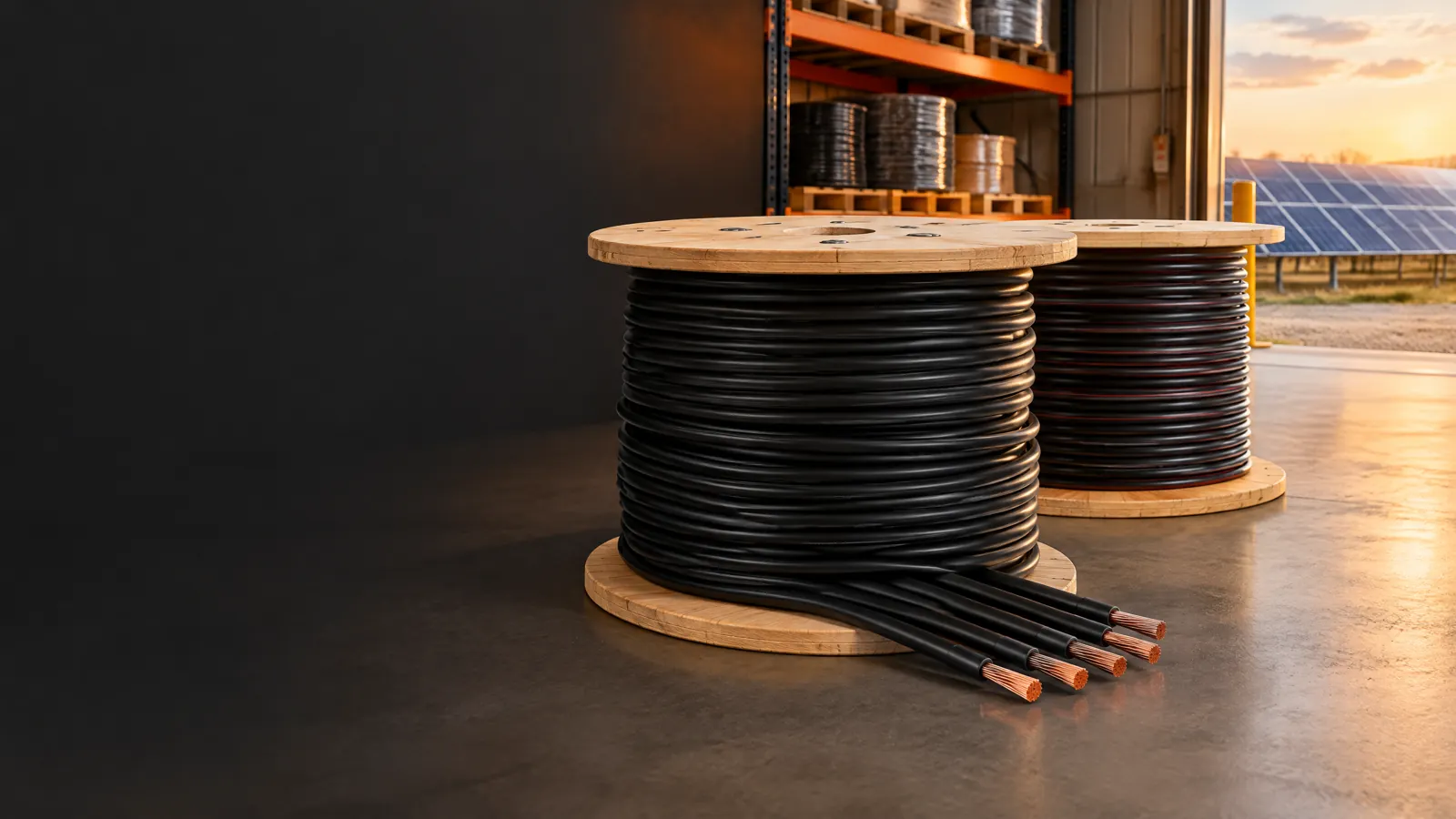
Welding Cable and Portable Cord Surplus Buyers
Have welding cable reels, unused welding leads, battery cable or leftover SOOW and SJOOW cord taking up inventory space? Contact Surplus Valve Buyer for our wire and cable purchase review. We are reviewing material offered for sale, not offering cable for customers to buy. Electricians, contractors, distributors, plants and other inventory owners can start by calling or emailing with the cable type, quantity, condition and city. Identified reusable stock is the focus; a pile of damaged cable is a different inquiry, and scrap purchasing is not confirmed.
Prioritize identified welding cable and portable cord
For this purchase review, start with clearly marked welding cable, SOOW portable cord and SJOOW portable cord on full or partial reels. List battery cable separately rather than combining everything under flexible copper wire. Unused project leftovers, distributor overstock and plant maintenance inventory should be described by individual product and continuous length. This organization helps distinguish a documented product from unidentified material.
A welding lead assembly is not the same inventory item as bulk cable. State whether you have bare-ended cable, an electrode-holder lead, a work-return lead or an assembly with connectors. Record each assembly's length and describe attached components separately. Other wire families in the same lot should have their own inventory lines rather than being counted as welding cable.
Welding cable: markings matter more than appearance
Welding cable commonly has a flexible stranded conductor, but flexibility alone does not establish its identity. Southwire's Royal® Super Excelene® welding cable specification, for example, describes Class M rope-stranded bare copper and a CPE jacket. Its sample printing includes the manufacturer, product family, conductor size, WELDING CABLE designation, listing information, voltage, temperature range and sequential footage. These are details to copy from your own stock, not ratings to assume for another product.
Identify AWG or kcmil exactly as marked, including distinctions such as 2 AWG versus 2/0 AWG. Provide a strand class or strand count if documented. Jacket diameter or a seller's description of heavy cable cannot replace the conductor size. Keep different sizes, jacket colors and product families separate so the review does not treat a mixed lot as one uniform reel.
Battery cable is not automatically equivalent to welding cable
Some specific welding products include battery-cable applications in their manufacturer literature. That does not make every welding lead interchangeable with every battery cable. Southwire's general-purpose automotive SGT specification describes flexible stranded copper with PVC insulation and nominal systems of 60 volts DC or 25 volts AC or less. Its welding product cited above is a different construction documented at 600 volts.
Copy any SGT, SGX or other battery-cable designation, SAE reference, temperature marking and product number that is actually present. Describe factory terminals and whether you are selling bulk cable or completed assemblies. Do not relabel unmarked battery cable as 600-volt welding cable based on gauge, color or flexibility. Matching manufacturer documentation and actual product markings establish the identity being offered.
SOOW and SJOOW: record voltage and conductor count
SOOW and SJOOW are distinct portable-cord designations. Priority Wire & Cable documents SOOW at 600 volts and SJOOW, the junior-service version, at 300 volts. The two O letters identify oil resistance of the insulation and outer jacket; the manufacturer describes W as weather/water resistance. Those designations do not mean that all flexible cord has identical construction, temperature limits or approvals.
Report the complete printed type, voltage, conductor gauge and number of cores. For a marking such as 12/3, confirm the corresponding size and conductor count against the label or product sheet, and say whether a grounding conductor is included in the stated count. Jacket color alone does not identify the internal conductors. Keep SOOW and SJOOW in separate lines even when both are black, the same gauge or similar lengths.
Describe reusable stock honestly, including storage and damage
Full reels, partial spools and continuous leftover lengths can be submitted with their identification and condition. State whether the cable is new and unused, opened but unused, or previously used. Original labels and packaging help connect a reel to its specification, but packaging alone does not prove the remaining cable is undamaged. Describe storage indoors or outdoors and disclose missing labels, crushed reels, taped areas or uncertain history.
Report cuts, exposed conductors, heat damage, cracking, corrosion, oil contamination and damaged plugs or terminals. Oil-resistant marking is not a reason to omit contamination. Mixed short pieces, stripped metal and burned cable are not the same as identifiable reusable inventory. This page does not confirm scrap buying or recycling capability, and submitting a lot does not mean it will be accepted.
Give length per reel, not just total weight
List each reel or coil with its own continuous length. Three separate 40-foot pieces are not one 120-foot length. Distinguish verified footage from estimates and identify the basis: original reel tag, inventory record, measurement or sequential jacket markings. A tag showing the original factory length should not be presented as the remaining quantity after cable has been removed.
Specify copper, tinned copper, aluminum or copper-clad aluminum only when supported by markings or documentation. Tinned copper is not aluminum, and copper-clad aluminum is not solid copper. Fiber cable is a separate product family, not a copper conductor equivalent. Total weight may help describe handling, but it does not replace material, gauge, core count, voltage and usable length in a product review.
Start a purchase review by phone or email
Call or email Surplus Valve Buyer using the contact details on this website. A brief inventory description is enough to begin; no complex lead form is needed. Include printed markings or product numbers, conductor material, AWG or kcmil, core count, voltage, length per reel, condition and your city. State that you own the inventory or are authorized by its owner to offer it for sale.
Photos are optional. If available, clear pictures of the jacket legend, reel label, overall stock and disclosed damage can clarify the description. Say what is unknown instead of estimating a rating. Any offer, acceptance, payment terms or collection arrangements require confirmation for the specific lot. Manufacturer and product names identify inventory only; they do not imply an affiliation or authorized-distributor relationship.