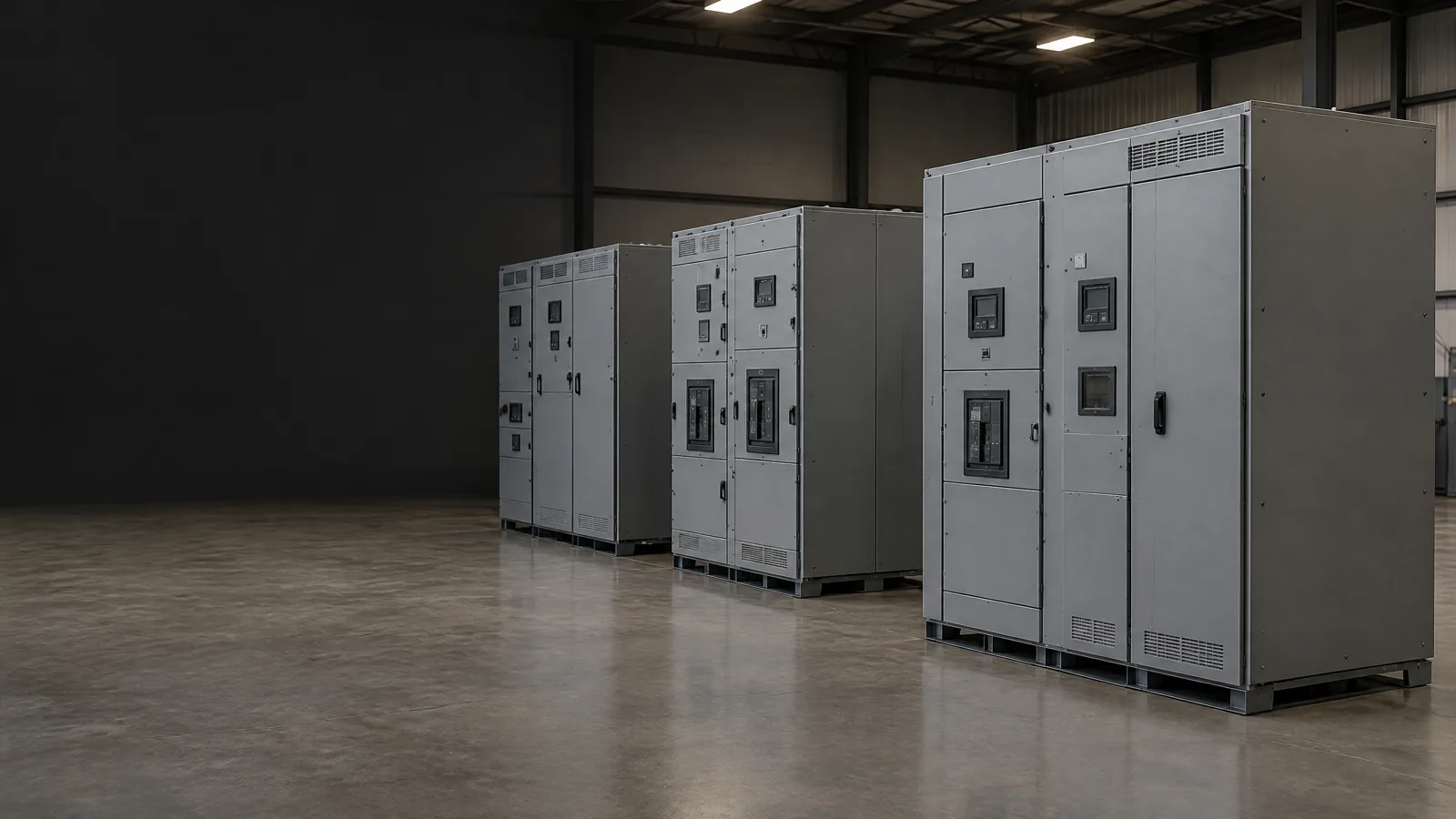
Switchgear Voltage & Amp Nameplate Guide
When you sell surplus switchgear, one voltage number and one amp number rarely describe the whole lineup. The assembly nameplate, breaker labels and existing drawings identify different things. This guide helps you report those details without confusing normal operating voltage, bus capacity or fault ratings. Surplus Valve Buyer is a Houston-based independent surplus buyer. We buy; you sell. Equipment eligibility and purchase terms are confirmed for each lot, not determined by a rating alone.
Start with safely readable external labels
Use records you already have and labels readable from a permitted, safe position outside closed equipment. Copy the manufacturer, assembly type, model, serial or shop-order number, voltage and amperes exactly. Identify whether a label belongs to the entire assembly, one section or a breaker. An exterior photo is optional; do not create electrical exposure to obtain one.
Do not open electrical compartments, remove deadfronts, rack breakers or enter energized gear for a quote. An off indication does not establish safety. Any internal identification or decommissioning belongs to qualified electrical personnel under the applicable isolation, lockout/tagout, stored-energy and absence-of-voltage verification procedures. Tell the buyer when a label cannot be safely accessed.
Keep nominal voltage separate from maximum voltage
Nominal system voltage describes the electrical system the gear served. Maximum rated voltage describes an equipment rating. Both can appear in project documents without being identical. Eaton explains that 15 kV maximum-rated switchgear commonly serves nominal systems such as 12.47 kV, 13.2 kV or 13.8 kV. Report the actual wording instead of replacing one figure with the other.
For example, an existing drawing may identify a 13.8 kV service while the assembly plate says 15 kV maximum. Those are separate useful facts, not necessarily a contradiction. Include frequency and AC or DC markings when shown. These examples explain labels; they do not establish suitability for another system or indicate which voltage-and-amperage combinations we will purchase.
Preserve wye, delta and slash markings
Do not shorten 480Y/277 V to 480 V when transcribing a label. The Y identifies wye notation. Eaton's breaker guide explains that a 480Y/277 Vac slash rating applies to a solidly grounded circuit with limits of 277 V conductor-to-ground and 480 V between conductors. It is not an unrestricted 480 V rating.
A breaker marking is not proof of the complete lineup's original system connection. Record explicit wye or delta identification from existing drawings or system records separately from equipment ratings. If the records say delta, preserve that description rather than translating it into wye notation. If the connection is unknown, say unknown. Do not inspect connections or take live measurements to answer a buyer's question.
Report continuous bus amperes as their own rating
Continuous current is the normal current-carrying rating, not a fault-current rating. Look for wording such as main bus continuous current or rated main bus amperes on the assembly documentation. Eaton's VacClad-W guide lists main-bus current separately from breaker current. Copy the main-bus value rather than substituting the largest breaker number you can see.
If the assembly plate says 2000 A main bus, report that exact rating. Do not add feeder-breaker ampere ratings together to create a bus rating. A meter reading describes a load at a particular moment; it does not replace the nameplate. When only a breaker label is available, identify its amperes as breaker information and leave assembly bus amperes unconfirmed.
Separate breaker frame, trip and settings
The breaker frame and its installed trip unit can carry different current markings. Eaton's molded-case breaker catalog explains that a frame has a maximum continuous-current rating and the trip unit has its own maximum rating, which must not exceed the frame rating. Neither number establishes the lineup's main-bus rating.
Record the breaker catalog number, frame designation and trip-unit model when available in existing records or safely visible labels. Include marked sensor or rating-plug information separately. An adjustable long-delay pickup setting is another detail, not automatically the frame amperage. Manufacturer notation varies, so preserve the printed labels instead of guessing what an abbreviation means. Do not change settings, operate controls or remove a trip unit to prepare a selling inquiry.
Distinguish interrupting kA from assembly SCCR
An interrupting rating describes the fault current an overcurrent protective device can interrupt at a specified voltage. SCCR means short-circuit current rating; for switchgear it describes the assembly's short-circuit withstand capability. These are not continuous operating amperes, and a breaker label is not a substitute for the assembly rating.
Keep the kA figure attached to its voltage and wording. A breaker may show different interrupting values at different voltages. Also preserve qualifiers such as rms symmetrical, asymmetrical or peak. Do not select the largest number from a label and call it the lineup rating. Tell the buyer which label supplied each figure. Missing assembly SCCR information should remain missing until supported by appropriate documentation, not filled in from a nearby breaker.
Keep short-time current and duration together
Short-time withstand is a current-and-time rating. The time is essential: a kA number alone omits part of the duty. Eaton describes a typical low-voltage switchgear short-time interval as 30 cycles, or 0.5 seconds at 60 Hz. Its VacClad-W assembly table separately identifies a two-second short-time withstand rating.
Transcribe the complete stated value, including seconds or cycles, frequency and any current qualifier. Do not treat a short-time withstand number as breaker interrupting capacity or continuous bus amperes. Similar-looking numbers can describe different duties. This distinction helps a buyer identify the equipment; it is not a basis for selecting protection settings, calculating available fault current or approving an installation.
Read BIL as an insulation withstand rating
BIL is a lightning-impulse insulation withstand rating, expressed in kilovolts. Eaton's VacClad-W guide labels it Lightning Impulse Withstand Voltage and distinguishes it from rated maximum voltage and power-frequency withstand voltage. The guide gives 95 kV peak BIL for its 15 kV class example. That does not make the gear a 95 kV operating-voltage assembly.
When selling medium-voltage switchgear, include BIL if it is documented, along with the maximum voltage rating. Keep peak notation and any separate power-frequency withstand entry. These identify insulation performance, not bus amperes or fault-interruption capability. Do not estimate BIL from cabinet dimensions, age or a voltage-class nickname.
Describe the lot, not just the ratings
Ratings identify important characteristics, but a selling inquiry also needs a clear description of what is included. State whether you have a complete lineup, individual sections or empty structures. Report included breaker quantities and models, known missing parts, visible condition and the equipment's location. Existing one-line drawings can help connect assembly details to individual sections.
If paperwork and labels disagree, send both descriptions with their origins rather than choosing the more attractive number. Disclose known modifications and unavailable records. Contact Surplus Valve Buyer to discuss your lot even when information is incomplete. Any purchase decision and payment, decommissioning, rigging or transport responsibilities must be confirmed for that specific equipment.